
Key takeaways: Organizational density and strategic diversity — not just lawsuits — determine whether opposition can win durable reforms. States with broad, multi-strategy coalitions are achieving legislative outcomes that no individual lawsuit can. Colorado's 54-organization coalition supporting SB 26-102 illustrates what Stage 5 resistance infrastructure looks like in practice.
In Learning to Oppose, we classify the state-level legal strategy of data center opposition organizations into three "tiers". In "Tier 1" states, data center opposition is mainly driven by grassroots organizations, which rely on zoning code violations to launch lawsuits to stop data center development. In Tier 2 states, national-level organizations step in to help organize the opposition. In Tier 3 states, legal strategy is driven by multi-state regional or national organizations that choose cases, provide counsel, and coordinate across state lines.
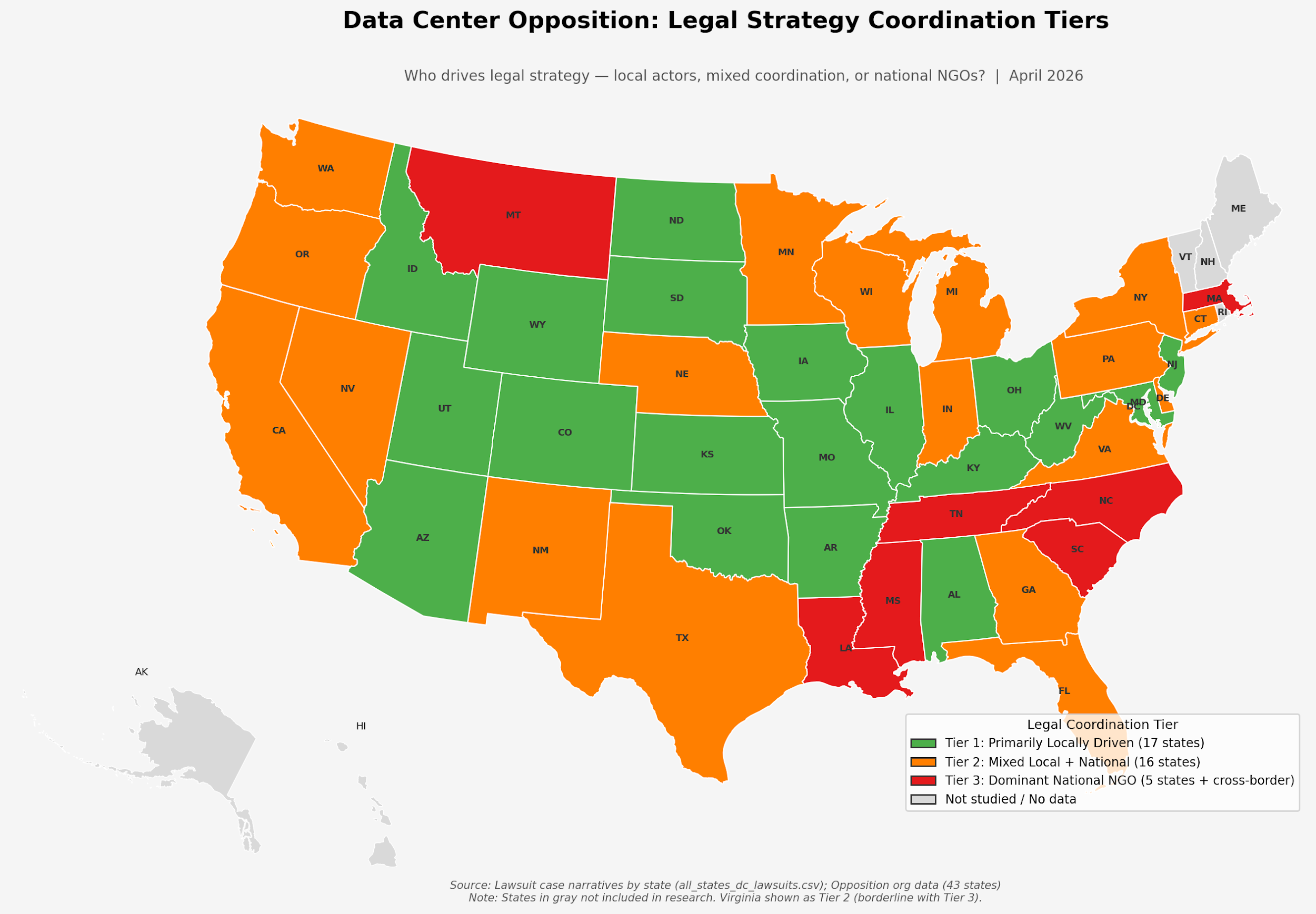
Lawsuits are only one piece of the puzzle.
While powerful when successful, lawsuits are rare, costly, and relatively infrequent. They're case-by-case wins. They don't necessarily set precedent for across-the-board reform. Furthermore, they are often only possible in contexts where zoning regulations provide them with legal leverage. Yet the absence of that leverage doesn't automatically spell the lack of community opposition. Instead, lacking a clear path to lawsuits, local opponents adopt other — and even more powerful — types of opposition strategies. For instance, many moratoriums and ordinances are introduced in Tier 1 states precisely because zoning codes make lawsuits impossible to win.
One might think, based on this, that lawsuits and moratoriums are "either-or" strategies, mutually exclusive in their appearance. But the data does not show this. In some states, like Ohio, zoning law is so inhospitable to plaintiffs that organizations pursue moratoriums instead. But in most states, lawsuits and moratoriums are jointly pursued.
In fact, a deeper analysis of oppositional organizations suggests that success, of any kind, breeds more success. When more organizations are active, pursuing a wide range of strategies, we see that: 1) counties enact more moratoriums and ordinances regulating data center zoning, and 2) citizens win more lawsuits against counties and public utilities commissions.
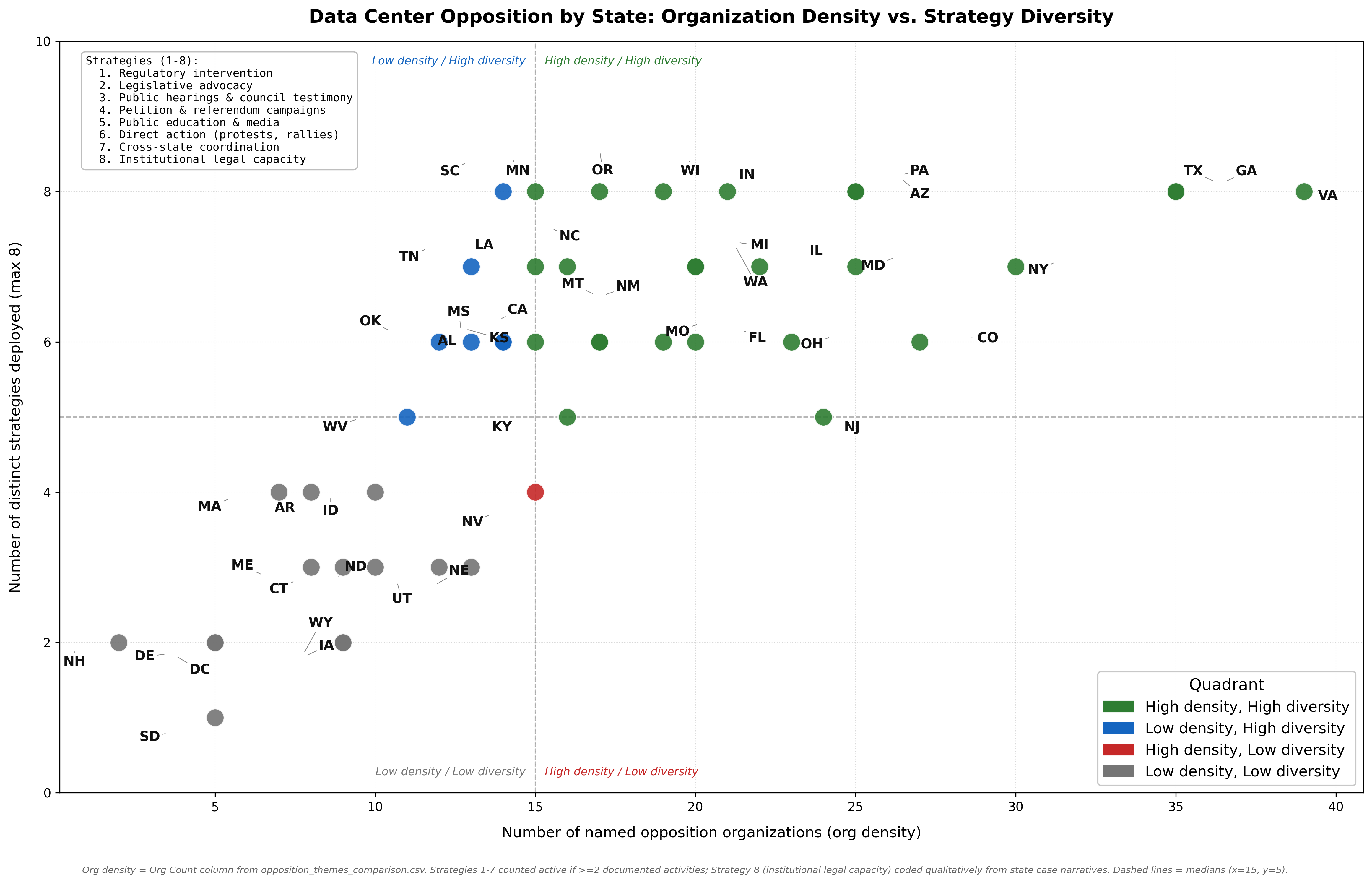
Density and diversity are the two key factors.
Simply put, the ability of organizations to effectively hinder the expansion of data centers hinges on two key factors: their density and diversity.
The number of organizations operating in a state, as well as the degree of collaboration among them, makes up the organizational density.
The types of strategic actions in which organizations engage define their diversity.
When it comes to data center opposition, there are eight discrete strategy categories of relevant opposition activities:
- Regulatory Intervention: Participating in public utility commission (PUC/PSC) proceedings, FERC filings, rate case interventions, environmental permit appeals, or administrative hearings.
- Legislative Advocacy: Introducing, supporting, or lobbying for state or local legislation (moratorium bills, zoning reform, ratepayer protection bills, tax incentive reform).
- Public Hearings & Council Testimony: Organized turnout at city council, county commission, planning commission, or zoning board hearings.
- Petition & Referendum Campaigns: Collecting signatures for petitions, recall elections, ballot initiatives, or referenda.
- Public Education & Media: Community teach-ins, investigative reporting, fact sheets, social media campaigns, press conferences, and public awareness efforts.
- Direct Action: Protests, rallies, marches, civil disobedience, and other forms of public demonstration.
- Cross-State Coordination: Sharing tactics, model legislation, or legal strategies with groups in other states.
- Institutional Legal Capacity: Presence of dedicated legal organizations (environmental law firms, public interest law centers, national NGOs with litigation programs) engaged in the state's opposition.
In some states, organizations lead citizens in a wide variety of strategies, from high-level lawsuits against public utilities commissions to large-scale turnout at public hearings and protests. In other states, organizations focus only on one or two strategies. It's still true that certain types of organizations specialize in certain types of legal strategy.
Applying social movement frameworks to data center opposition, we're finding that when a state has a range of organization types pursuing a range of actions, there's a new kind of heft to the opposition movement: there are stages to the infrastructure of resistance.
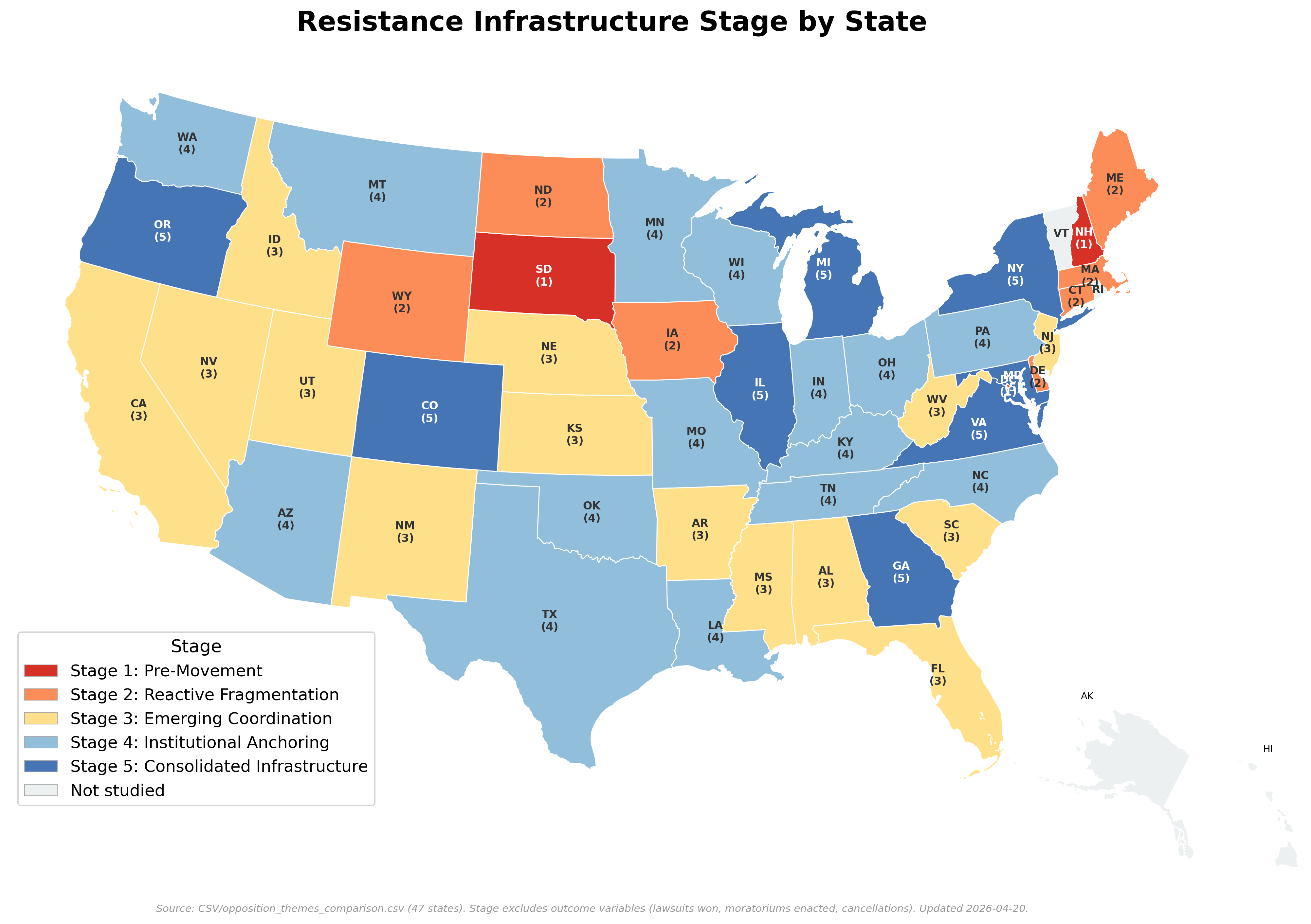
Five stages of resistance infrastructure.
What do these resistance stages look like? Stage 1 and 2 states are characterized by fewer, local organizations engaged in one or two oppositional strategies, and not much collaboration. In stage 3 and 4 states, one or two national organizations are in the mix. They've begun organizing mobilization, engaging in a wider variety of strategies. Yet only in stage 5 states are there formal coalitions between grassroots and national NGOs, with multi-year activity and coordinated agendas. Think the Virginia Data Center Reform Coalition.
The Michigan example.
Take Michigan, for example. You might see a relative absence of data centers in Michigan, and assume both a low degree of community opposition and a general lack of organized protests. Yet, data center developers have faced a vastly different reality. Proposed hyperscaler projects like a 1.4 GW Oracle/OpenAI campus backed by Related Digital have led to significant citizen pushback. Relative to other states with advanced resistance infrastructure, Michigan's strategic diversity doesn't look deep if we look at the volume of activities in each of the eight strategy categories.
Yet, we still see opposition actors using a broad set of tactics in Michigan. Food & Water Watch, the leading organization pushing for a national moratorium on data centers, is active there, having coordinated similar campaigns in Arizona, Georgia, and Texas. The National Coalition Against Cryptomining brings experience from North Carolina and other states to Michigan's Upper Peninsula communities. Meanwhile, grassroots groups are also active: farmers in Livingston County, parents near a charter school in the Upper Peninsula, and suburban homeowners in Washtenaw County have all independently organized against proposals in their communities.
The Colorado example.
There are other surprising findings: Colorado, a state with zero current lawsuits related to data centers, has a more sophisticated resistance infrastructure than Pennsylvania, where nine lawsuits against data centers are pending. How can this be? The answer is that Colorado's mobilization is centrally coordinated, led by a 54-organization coalition, which is supporting SB 26-102, a bill which, if passed, will essentially block most data center development. This will happen by — among other provisions — requiring data centers to source 100% renewable energy and pay the full cost of grid infrastructure.
Why diversity in organizational strategy matters.
Passing legislation regulating data centers is the gold standard for anti-data center mobilizers. Unlike moratoriums, legislation like Colorado's SB 26-102 is permanent and applied across the board. But passing legislation is far from easy. It requires broad-based political support from within state legislatures. This is when the strategic repertoire of collaborating organizations, and vertical coordination, begins to really matter.
State senators and state representatives serve four-year terms, and they are sensitive to electoral pressures from constituents. Thus, for legislative reform to be successful, it needs larger swaths of residents — not limited to those directly affected by data centers — to become politicized. It requires a horizontal transmission of an "opposition mentality." Lawsuits, while powerful weapons which have successfully delayed many individual data centers, do not mobilize a broad base of support.
Such broad-based electoral pressures are built up through cumulative increases in citizen opposition — ranging from public education to organized town halls and teach-ins. And when it comes to educating and mobilizing citizens, organizations that share knowledge and resources, try a variety of approaches, and can appeal to a wide swath of citizens, tend to win.
What does this mean? A state with few active organizations pursuing only one or two strategies is categorically different from one with dozens of groups deploying the full range — from PUC filings and legislative lobbying to marches and cross-state coordination. The resistance infrastructure stage is a leading indicator of where legislative risk is headed next, ahead of any individual lawsuit or moratorium vote.