There are several types of organizations active in data center politics: local grassroots groups that form in response to data center projects, established environmental NGOs at the state level, and established environmental NGOs at the regional and national level. There are several distinct ways that opposition organizations — especially local ones — learn strategy.
1. Local actors learn by watching neighboring regions.
For example, Aurora, IL's City Council recently passed a 180-day moratorium on data centers, then quickly rolled out a set of stringent data center regulations, requiring third-party noise studies, water reports, energy audits, 1,500-foot setbacks for generators, and on-site renewable energy. It is likely that surrounding municipalities in Illinois are drawing insights from Aurora's moratorium-to-regulation pathway.
2. Local organizations connect to regional nonprofits and learn multi-state strategies.
Southern Environmental Law Center (SELC) applies similar strategies across different states. In the Carolinas, SELC's main tactic has been to file multi-claim zoning lawsuits with local co-plaintiffs. For example, the organization is currently suing Colleton County in South Carolina, where a proposed 1,000 MW data center borders the ACE Basin — a 1.7-million-acre protected watershed in South Carolina's Lowcountry. SELC's claims include multiple layers: that the county violated its own zoning code when it rezoned agricultural land for industrial use through a "special exception" clause; that the county failed to publicly disclose information about the project; and that the rezoning conflicts with the county comprehensive plan.
SELC is selecting similar cases in states with similar regulations. Their ACE Basin case appears similar in framing to other cases they are preparing to litigate in Alabama and Tennessee, states with similar agricultural rezoning dynamics. If the Colleton County ordinance challenge succeeds on the theory that a county cannot create a zoning "special exception" that conflicts with its own comprehensive plan, this is a durable precedent they can carry over to other states.
3. Cross-state coalitions learn from each other directly.
In April 2026, mobilizers in Texas convened a two-day event, Data Center Rebellion. Attendees were not limited to Texas residents: a handful of Arizona organizers also attended. It is likely that we will soon see similar mobilization strategies across the two states. In another case, the San Marcos, TX zoning denial win became a model for organizers in other states.
Three tiers of legal strategy coordination.
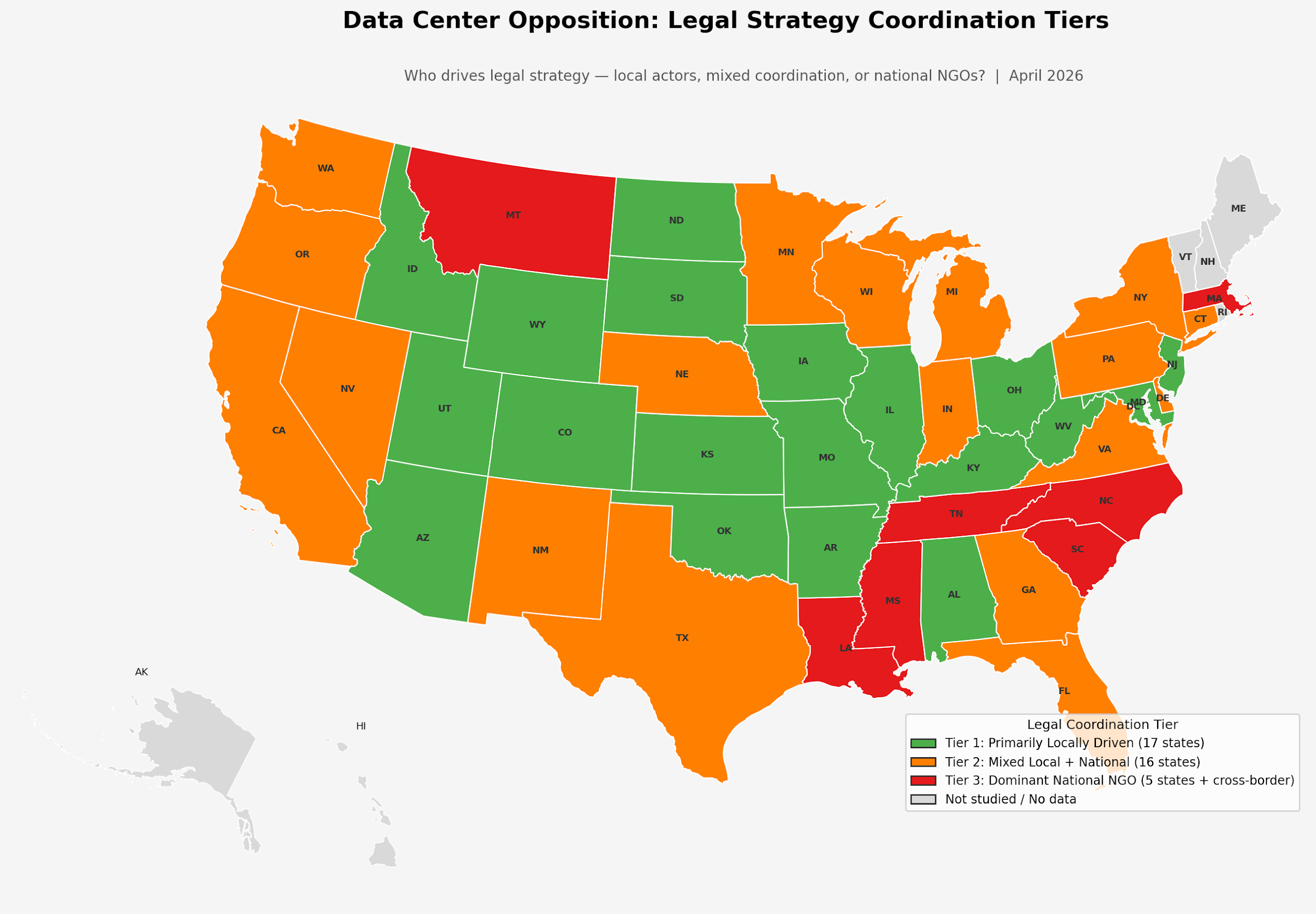
Tier 1 — Locally Driven (17 states): Grassroots groups retain private attorneys and pursue procedural legal theories — inadequate notice, spot zoning. Moratoriums are preferred over litigation.
Tier 2 — Mixed Local + National (16 states): State-level organizations (MCEA-MN, MEA-WI, NMELC-NM) are legal engines. Earthjustice provides targeted interventions. Local grassroots groups achieve independent wins.
Tier 3 — Dominant National NGO (5 states + cross-border): SELC anchors the Southeast (NC, SC, GA rate case, TN/MS). Earthjustice anchors MT, LA, and targeted cases in 9 states. This tier has the highest win rate.
Why vertical collaboration matters.
Opposition organizations at different levels benefit when they collaborate vertically across tiers. The lawsuits show this clearly: local and grassroots organizations benefit from the legal expertise national NGOs bring to complex claims — utility rate or some environmental claims. Meanwhile, national NGOs benefit from having local co-plaintiffs to lend them legitimacy and community standing.
Most collaborations occur within states, not between them. This applies especially for movements that are more established and connected to an institutional actor, such as a regional or national NGO, or a coalition. Some examples of high-collaboration states — where at least three-quarters of organizations have a connection — are Colorado, Montana, and Georgia. Low-collaboration states, where movement-building is still in early stages, include Idaho, Arkansas, and Wyoming. This maps neatly onto the legal strategy coordination tiers above, showing how vertical collaboration and horizontal connections are linked.
Here’s a neutral, balanced rewrite that applies to both groups: *** What does this mean for stakeholders? The pace at which strategies evolve and spread is accelerating. Actions that success in one county, quickly inform tactics elsewhere. The Data Center Rebellion convening, SELC's multi-state litigation template, and Aurora's moratorium-to-regulation model are all examples of strategies that will spread. Monitoring organizational networks, not just individual cases, can help anticipate emerging developments. *** Would you like this to lean more toward policy analysis or remain broadly accessible?.