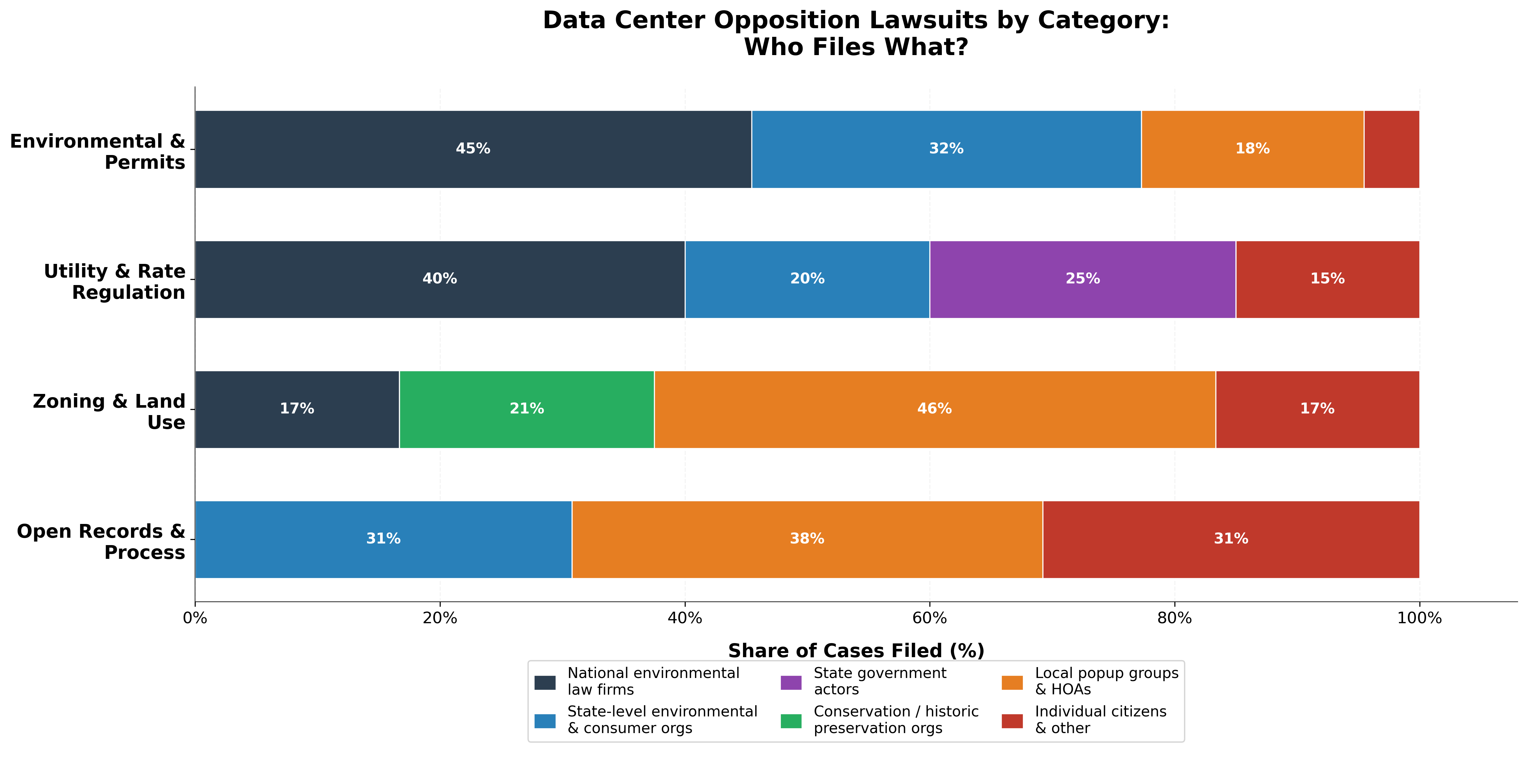
Different types of organizations tend to adopt distinct legal approaches when contesting data center developments. These approaches can be grouped into four categories: zoning and land use, environmental and permitting, utility and rate regulation, and open records and process. In addition to differences in leadership, legal strategies vary by region. They also differ in cost—for both data center developers and the communities involved—as well as in their rates of success.
Local grassroots opposition champions zoning and transparency lawsuits, while regional and national NGOs dominate in environmental, permitting, utility, and rate regulation lawsuits.
Zoning and land-use lawsuits.
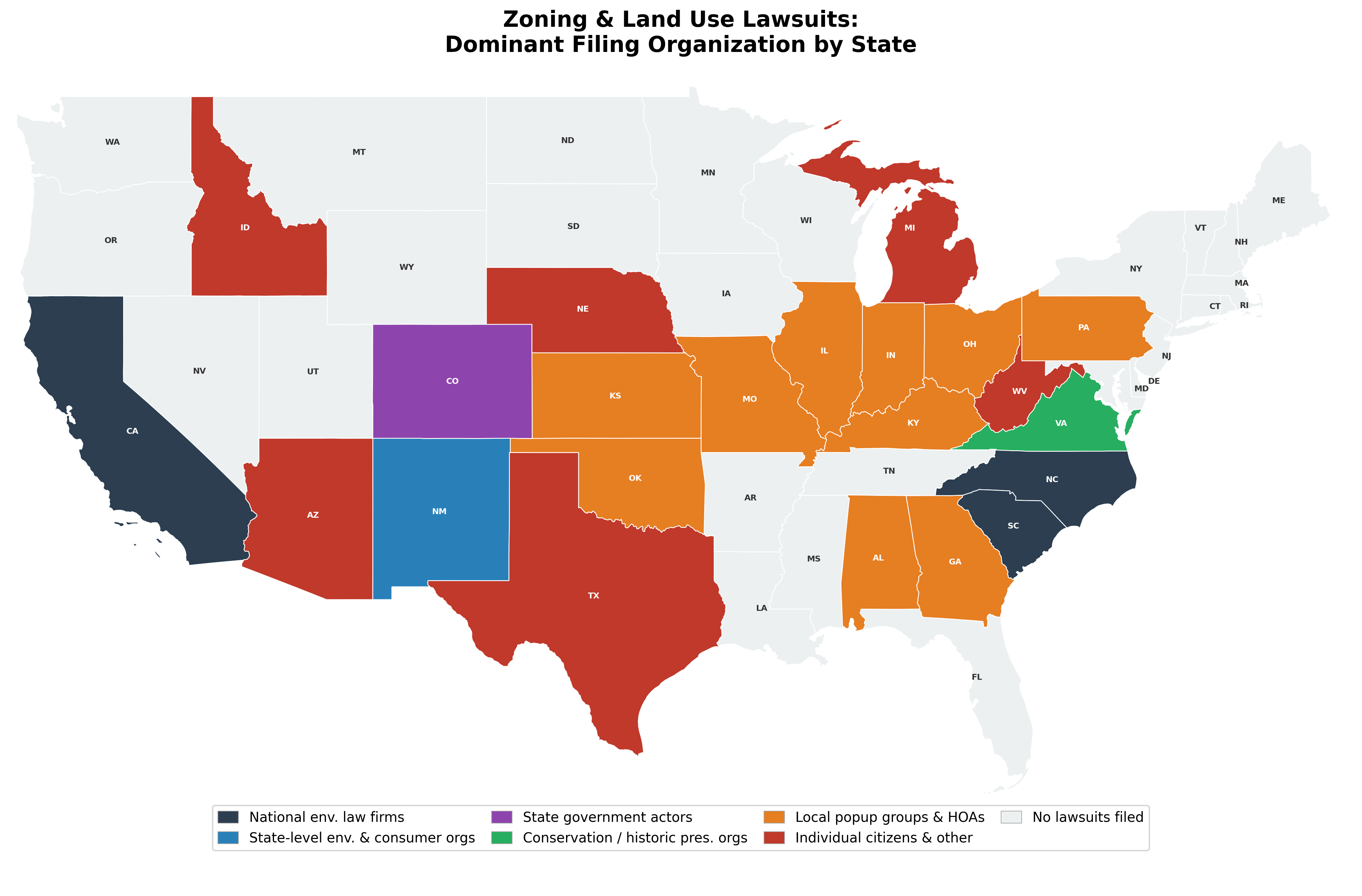
Zoning and land-use lawsuits challenge rezoning decisions, violations of county comprehensive plans (see our piece on county-level planning authority), deed restrictions, and annexation procedures — such as when a municipality wants to incorporate previously unincorporated land. For the moment, zoning and land-use lawsuits are most prevalent in Virginia, New Mexico, Oklahoma, and Indiana.
Zoning and land-use lawsuits are primarily driven by reactive local groups that focus on procedural failures as a basis for their lawsuit. Thus far, 63% of these types of lawsuits are filed by grassroots organizations or resident groups formed in response to data center plans — in contrast to environmental permitting and utility rate lawsuits, which are almost exclusively filed by national NGOs. These local groups focus on procedural failures: inadequate public notice, failure to hold required public hearings, spot zoning inconsistencies.
When national NGOs enter the zoning arena.
A notable exception: some regional and national NGOs do enter the zoning lawsuit mix, despite it being a primarily locally-driven phenomenon. The Southern Environmental Law Center (SELC) is building a multi-state strategy around zoning lawsuits which they originally successfully applied in the Carolinas, partnering with local co-plaintiffs — individual residents and partnering local nonprofits — who bring community legitimacy while SELC supplies legal capacity.
In comparison to grassroots organizations' zoning lawsuits, which tend to focus on a city's failure to follow its own procedures, SELC builds multiple claims on top of zoning suits: cultural heritage claims, county comprehensive plan violations, zoning code violations, and conservation arguments. SELC is currently testing this multi-tiered strategy through a lawsuit filed in early 2026.
Why this matters: If SELC wins their zoning lawsuits filed in early 2026, they have a replicable model they can apply to other states where rezoning agricultural land is an issue — Alabama and Tennessee in particular.
Open records and transparency lawsuits.
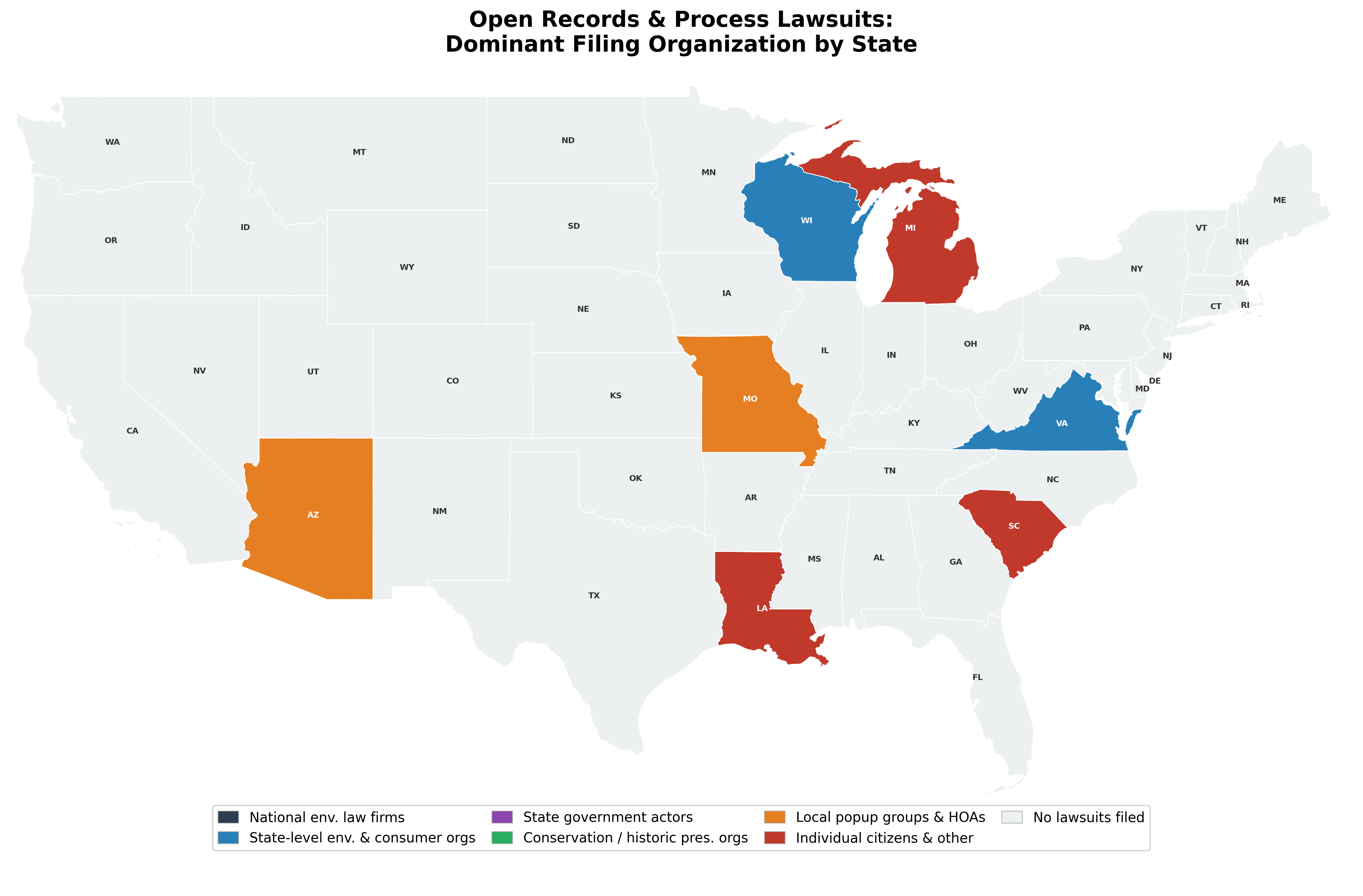
Open record lawsuits go after data center non-disclosure agreements (NDAs), FOIA denials, and meeting law violations — targeting closed-door agreements between governments and data center projects.
There are fewer open records cases than other lawsuit types, but the technical complexity is low compared to environmental and utility lawsuits. As the barrier to entry is low, they are more accessible to individual residents without institutional legal support. Individual residents and state-level transparency organizations have found real success in Wisconsin, Virginia, and South Carolina — successfully stalling or blocking data center developments. Despite its relatively low prevalence thus far, this is a notable and growing legal strategy.
Who wins?
Not all lawsuit types are equally successful, and not all organizations are equally effective. The chart below shows win rates by organization type across all lawsuit categories combined.
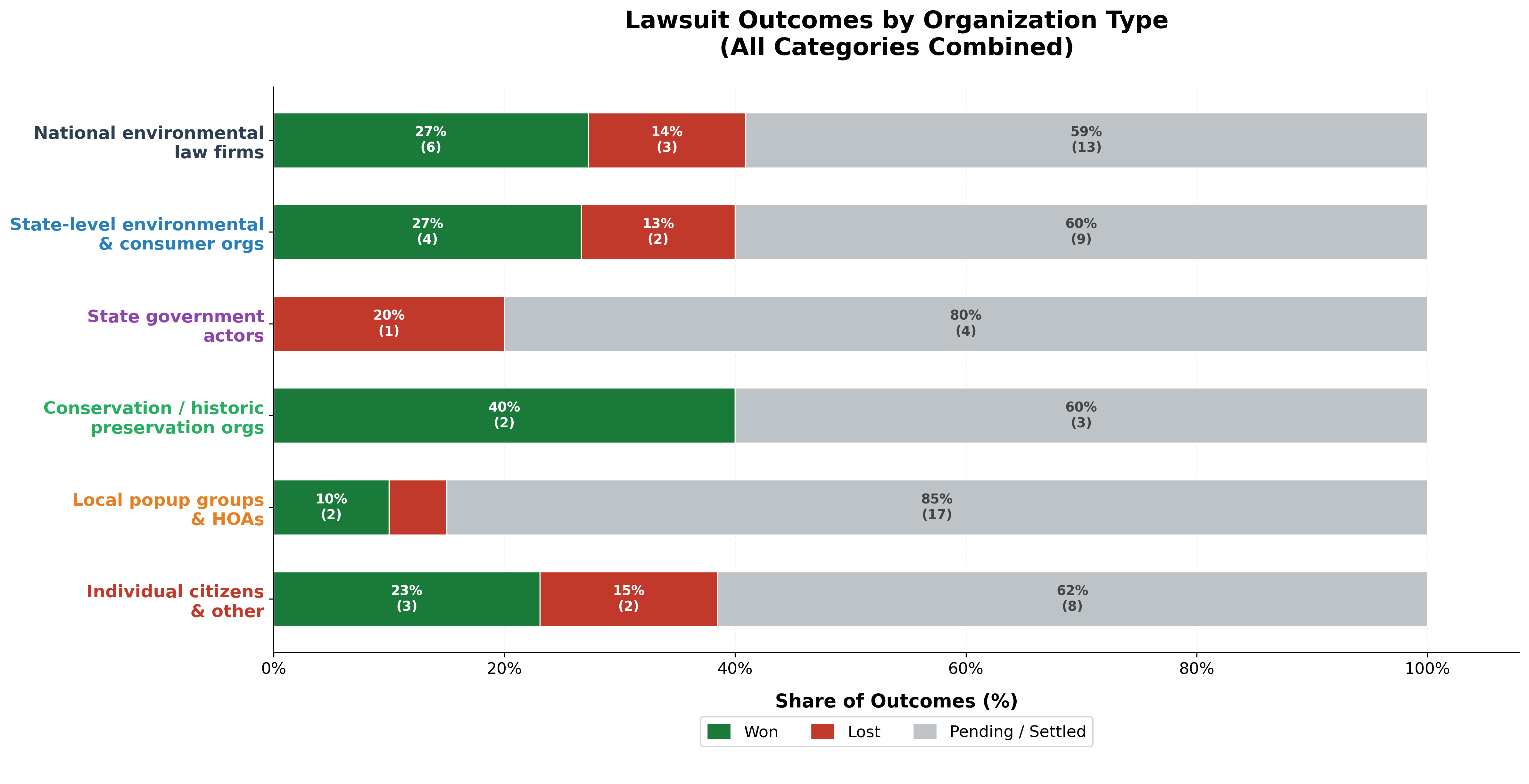
What does this mean for data centers and the communities they inhabit? Local opposition to data centers is getting more sophisticated — and more strategic. From low-cost zoning challenges led by grassroots citizen groups to complex environmental and utility lawsuits driven by national NGOs, communities are learning how to use the law to slow, reshape, or even stop data center expansion. Each lawsuit type reflects a distinct blend of local legitimacy, technical expertise, and political leverage — each carrying its own costs and likelihood of success for both opposition groups and data center developers.