
Key takeaways: Moratoriums are more successful when pursued before developers attain permits or zoning approvals. Moratoriums cluster, and clusters adopt different strategies in different states. Within clusters, moratoriums can spread among counties and townships with similar profiles. In pro-business states with weak local governance, moratoriums are a last-resort choice.
Across the country, county and township councils are racing to hit the pause button on frenetic data center development while they rewrite local zoning laws and ordinances. In this piece, we examine patterns in how counties adopt moratoriums and how different paths to moratoria affect their success rate.
In theory, moratoriums are not limited to the county level. Yet, in practice, no state has yet enacted a state-wide moratorium on data center development. Thus far, moratoriums on data center development have been discussed and passed in 76 counties and townships; and discussed but not passed in 33 counties and townships across the U.S.
Moratoriums cluster, and clusters differ.
What do these counties have in common? It depends on the state. Moratorium strategies are clustered: once one county begins discussing the possibility of a moratorium, its neighbors take note, leading to a visible clustering of the practice. Each cluster has a different profile.
Once established, moratoriums spread in recognizable patterns. In Indiana, the spread appears contiguous among agricultural counties in the north-central agricultural belt. In Ohio and Michigan, it is suburbs surrounding major cities that are moratorium-active: near Toledo, Akron, Columbus, and Detroit. And in Georgia, moratoriums are concentrated in the Atlanta metro area, in urban and exurban counties.
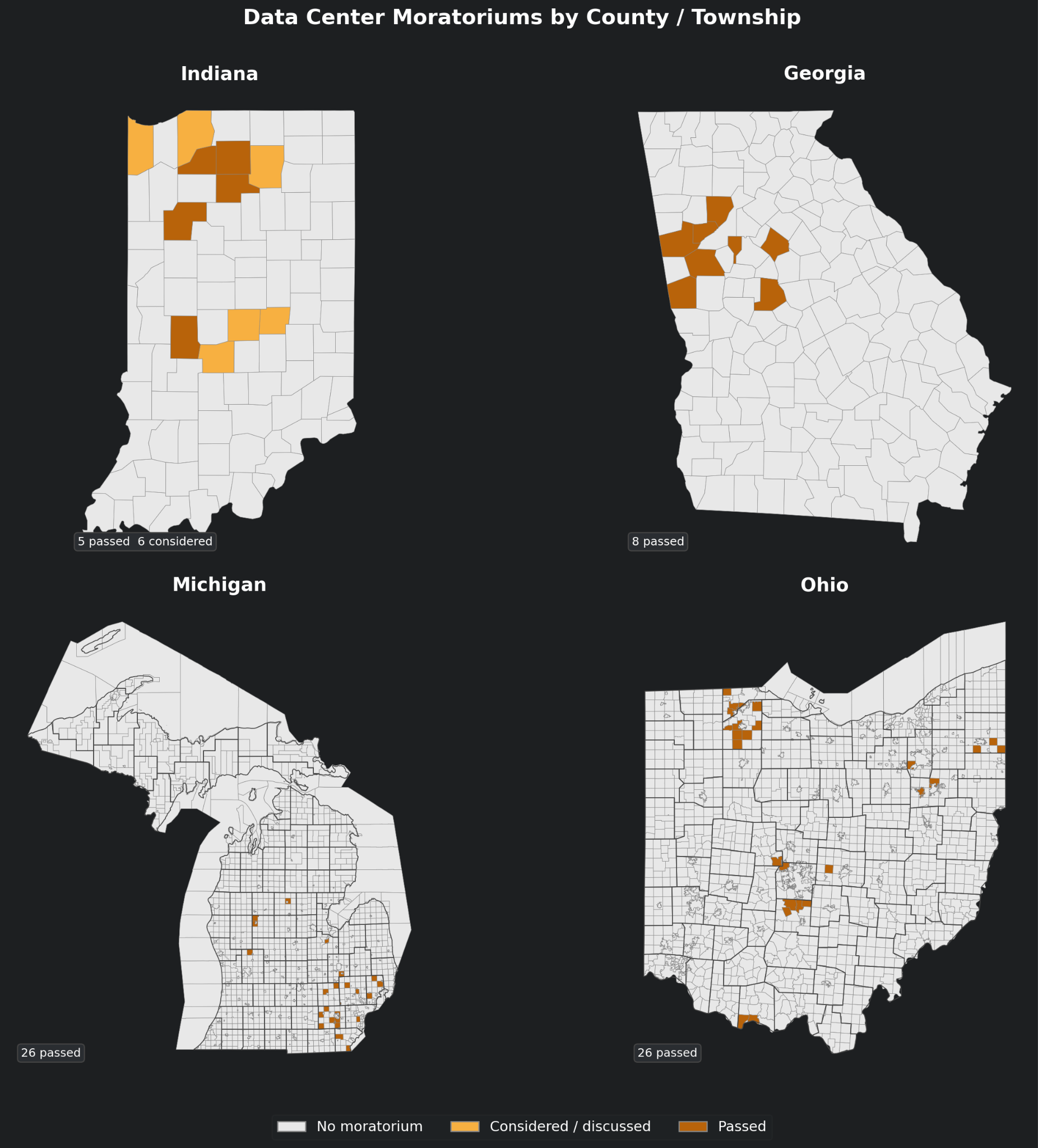
Let's deep dive into the Indiana cluster, where five counties have passed moratoriums on data center development. These five counties are all agricultural communities with lower budgetary revenues, on average, than other Indiana counties which have not passed moratoriums. All five counties passed moratoriums preemptively, before fielding any proposals from data center developers. On the other hand, in Georgia, Michigan, and Ohio, moratorium activity is concentrated in urban counties and townships which raised the issue after data center developers approached them.
The Indiana road to moratoriums was uncoached, spontaneous, and largely limited to agricultural counties which are relatively contiguous. This is quite different from other moratorium clusters. Michigan and Georgia, for example, have long-time national NGOs which are mobilizing grassroots coalitions. Unlike Indiana's cluster — where the Marshall County attorney wrote the moratorium language himself, with no outside counsel — these clusters seem more coordinated.
Moratoriums against data centers, then, are not isolated instances. Like living organisms, moratoriums behave distinctly in different contexts. They spread along different channels.
Early mobilization matters.
Across the board, our research shows that timing matters. 52% of counties which attempted to pass a moratorium before data center developers received approval were successful. Only 33% of counties which began mobilizing after data center developers already inked deals were successful.
This is because once a developer obtains a permit or rezoning approval, they acquire "vested rights" under U.S. property law. Later ordinances or moratoriums can be ruled procedurally improper or are blocked outright by the county commission before reaching a vote. In some cases, developers were able to successfully sue county councils which attempted to pass ordinances after rezoning approvals were submitted.
Case study — Lansing Town, NY: In September 2025, concerned citizens began discussing a moratorium while the town council drafted a new zoning code to hold data centers to stricter renewable energy, noise, and water use requirements. But the conversation ran too long. In December, just two weeks before the moratorium vote, the Zoning Board of Appeals approved TeraWulf's appeal to classify the project as a general processing facility — an allowable use under existing zoning. Because this approval came before the moratorium vote, the town board was forced to withdraw the moratorium entirely.
The power of vested rights hands considerable leverage to developers. Vested rights have been invoked in three major lawsuits: by Amazon after a new Board of Supervisors in King George County attempted to rescind an already-approved land rezoning; by Centra Logistics after the Henrico Planning Commission attempted to block their data center project; and by Starwood Digital after the Delaware Department of Natural Resources attempted to deny permits to its Project Washington.
Indiana is a perfect example of the power of early preemption. In 2024, Marshall County began a preemptive conversation about a possible moratorium with no active developer interest. Commissioners saw ongoing construction in nearby counties and acted. The county attorney drafted a simple document. When the moratorium was not challenged under state preemption doctrine, nearby agricultural Fulton County soon passed a similar moratorium, kicking off a chain reaction. Notably, none of the Indiana counties with moratoriums had any data centers under construction or even permitted when moratoriums passed — a pattern unique to Indiana.
Moratoriums still occur in pro-business states with weak county governance.
In some states, moratorium pushes are a last-resort choice, pursued when other means — such as lawsuits — fail. In Ohio, a very successful push to enact moratoriums on data center development is directly linked to the difficulty of gaining leverage via lawsuits. The state combines weak township zoning authority and an absence of a unified rural land-use planning framework with an aggressive data center attraction policy.
Lacking the legal tools to shape local development, communities in Ohio have embraced moratoriums and bans over the more usual practice of rezoning hearings. None of the dominant modes of legal action — filing challenges to approved land rezoning, permit appeals, or nuisance lawsuits — occur in Ohio. Instead, the legal battleground has shifted to the legislative and ballot-initiative arena: approximately 18 municipalities enacted moratoriums or bans by early 2026, and a proposed constitutional amendment to prohibit large data centers exceeding 25 MW appeared on the March 2026 ballot. Ohio — a Rust Belt state with high unemployment and a legacy of distrust of tech corporations — seems to have created a perfect storm where citizens embrace moratoriums as their weapon of choice.
What does this mean for data center developers and host communities? Local clusters play an important role, and each operates within its own specific dynamics. In states with generally pro-business environments and comparatively limited county authority—conditions that may otherwise support data center development—moratoriums can still emerge as a policy tool, at times used as a last-resort measure by local stakeholders.